How to Choose Eco-Friendly Nail-Free Adhesive: Solvent-Based, Water-Based, Modified PU and MS Compared
A practical guide for buyers, distributors, renovation channels, and OEM customers comparing solvent-based, water-based, MS polymer, and modified polyurethane nail-free adhesives by odor, VOC, environmental performance, and application.
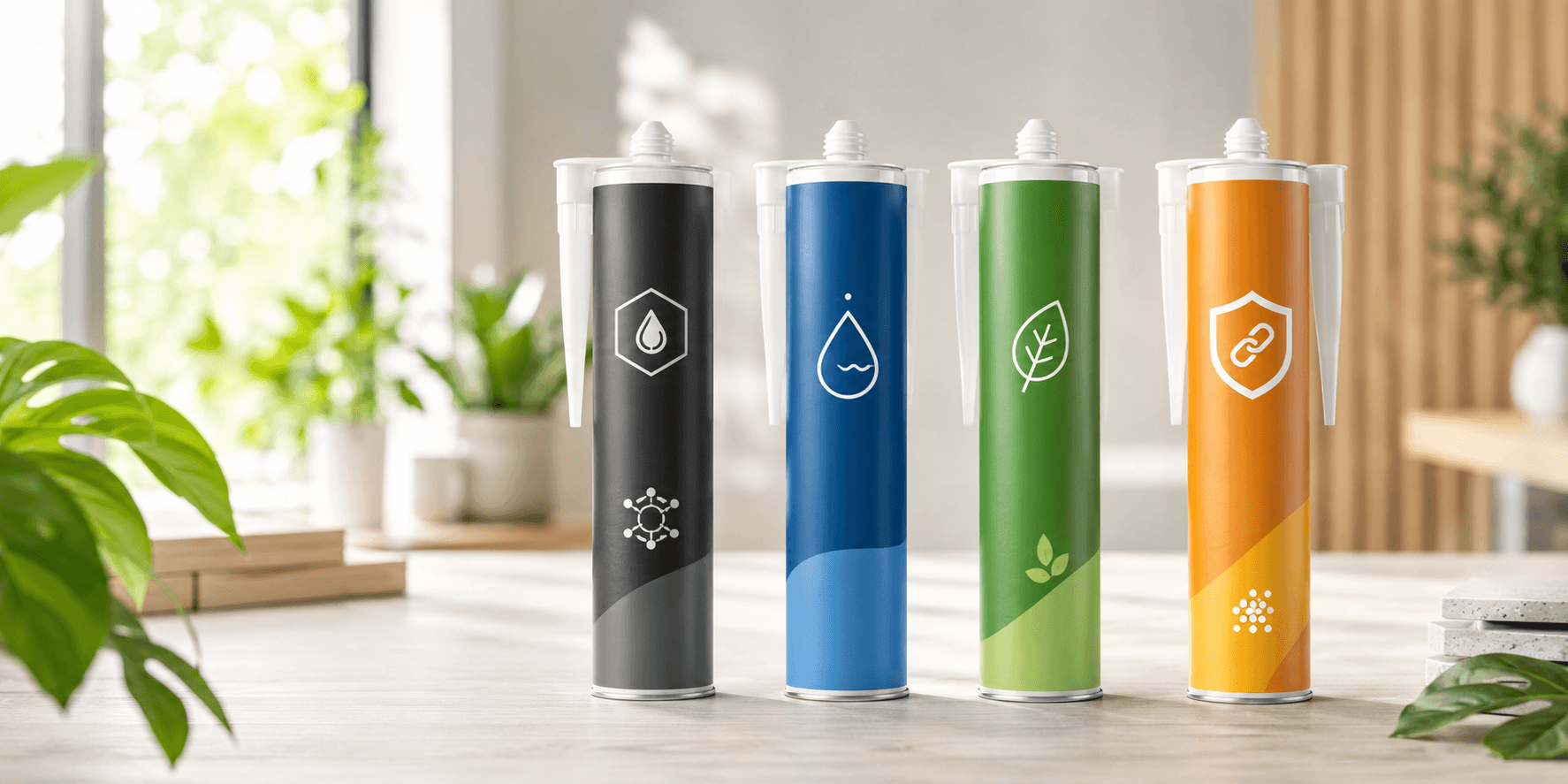
How to Choose Eco-Friendly Nail-Free Adhesive? Solvent-Based, Water-Based, Modified Polyurethane and MS Adhesives Compared
Nail-free adhesive is now a common bonding product in building materials, renovation, furniture, windows and doors, and construction accessory markets. Buyers used to focus mainly on bonding strength, curing speed, and price. Today, more customers also ask about odor, VOC level, indoor safety, and whether the product is suitable for homes, children's rooms, schools, hotels, apartments, and other odor-sensitive projects.
This is why eco-friendly nail-free adhesive, low-odor adhesive, low-VOC adhesive, MS adhesive, water-based adhesive, and modified polyurethane adhesive are becoming more popular.
Different nail-free adhesives may look similar, but their curing systems, odor sources, environmental performance, and application scenarios can be very different.
Quick Conclusion: For Eco-Friendly Product Lines, Focus on MS, Water-Based, and Modified PU Adhesives
If your target customers care most about low odor, indoor environmental performance, application comfort, and end-user acceptance, consider these systems first:
- MS polymer nail-free adhesive
- Water-based nail-free adhesive
- Modified polyurethane adhesive
If your market prioritizes price, fast setting, strong initial grab, and traditional channel volume, solvent-based nail-free adhesive still has a place, but odor, VOC, and ventilation requirements need more attention.
In simple terms:
- Solvent-based nail-free adhesive: competitive cost and strong initial grab, but more noticeable odor and VOC concerns.
- Water-based nail-free adhesive: low odor and suitable for light to medium interior decorative bonding.
- MS adhesive: low odor, low VOC, paintable, and suitable for many substrates, especially for medium and high-end interior and exterior applications.
- Modified polyurethane adhesive: combines PU strength with the low-odor and eco-friendly advantages of MS systems, suitable for customers who need strength, elasticity, and environmental performance.
Solvent-Based Nail-Free Adhesive: Fast Bonding and Lower Cost, But Higher Environmental Pressure in Europe and North America
Solvent-based nail-free adhesive is a traditional and widely used product type. It normally relies on organic solvent evaporation to build bonding strength.
Its advantages are clear: strong initial grab, fast positioning, easier cost control, and good suitability for hardware stores, standard building material channels, basic renovation, and price-sensitive markets.
However, its environmental concerns mainly come from solvent evaporation. The noticeable smell during application is often caused by solvents. For enclosed spaces, indoor renovation, children's rooms, schools, hospitals, hotels, and apartments, customers usually care more about odor, VOC, and indoor air quality.
From our long-term cooperation with customers in Canada, the United States, and Europe, we have also seen this trend clearly. Solvent-based nail-free adhesives are becoming harder to match local expectations for VOC and indoor environmental performance. In Canadian market samples provided by customers, traditional solvent-based products are now much less common, while low-VOC, low-odor, solvent-free, or eco-friendly systems are becoming mainstream.
Solvent-based nail-free adhesive is not unusable, but it is better suited for:
- Price-sensitive markets
- Standard renovation applications requiring strong initial grab
- Well-ventilated construction environments
- End users with lower odor requirements
- Traditional hardware, building material, and wholesale channels
For customers developing eco-friendly, low-odor, or high-end interior adhesive product lines, solvent-based adhesive may not be the best first choice. For Canada, the United States, Europe, and similar markets, MS polymer adhesive, water-based nail-free adhesive, and modified polyurethane adhesive are stronger upgrade options.
Water-Based Nail-Free Adhesive: Low Odor and Friendly for Interior Decoration
Water-based nail-free adhesive usually uses water as the dispersion medium. After application, water evaporates or is absorbed by the substrate, and bonding strength develops gradually.
Its biggest advantages are low odor, better application comfort, and stronger suitability for indoor use.
Common applications include:
- Skirting boards
- Gypsum lines
- Decorative profiles
- Wood panels
- Wall decorative materials
- Lightweight boards
- Interior repair
- General home renovation accessories
For home improvement and retail channels, “low odor, eco-friendly, and easy to clean” are selling points that end users can understand immediately.
Water-based adhesive also has limits. Because it depends on water evaporation, curing is affected by the construction environment, substrate absorbency, temperature, and ventilation. If both bonding surfaces are non-absorbent, or if the environment is humid or cold, curing speed and final strength may be affected.
Therefore, water-based nail-free adhesive is better for light to medium interior decorative bonding, rather than heavy-duty bonding, long-term water immersion, or high-strength engineering applications.
MS Polymer Nail-Free Adhesive: A Key Direction for Low-Odor and Medium-to-High-End Product Lines
MS adhesive, also known as MS polymer adhesive, silane-modified adhesive, or modified silane adhesive, has become very popular in medium and high-end construction and renovation markets.
Unlike solvent-based nail-free adhesive, MS adhesive usually does not rely on large amounts of solvent evaporation. It cures with moisture in the air and forms a stable elastic bonding layer.
Typical advantages include:
- Low odor
- Low VOC
- Solvent-free formulation options
- Better indoor application experience
- Good elasticity
- Good weather resistance
- Paintability
- Broad substrate compatibility
Our MS adhesive has passed VOC testing by an authoritative Chinese testing institution, and the report has an internationally recognized basis. For the Canadian VOC requirement applicable to the customer's market, where the limit is 5%, our MS adhesive test result is only 1.5%. This means it meets the requirement with a strong safety margin and is suitable for markets such as Canada, the United States, and Europe where low VOC, low odor, and indoor environmental performance matter.
MS adhesive can be used for:
- Interior decoration
- Skirting board installation
- Wall panel installation
- Wood bonding
- Metal bonding
- Tile, stone, and concrete bonding
- Door and window installation
- Kitchen and bathroom areas
- Hotels, apartments, schools, hospitals, and other odor-sensitive projects
- Medium and high-end OEM/ODM eco-friendly product lines
For distributors and brand owners, the value of MS adhesive is not only environmental performance. Its overall balance is the key: bonding, sealing, elasticity, weather resistance, low odor, and paintability can be combined in one product, making it suitable for high-end renovation adhesive, eco-friendly nail-free adhesive, and indoor-outdoor universal adhesive lines.
Modified Polyurethane Adhesive: Combining PU Strength with MS-Like Low-Odor Advantages
When many customers hear “polyurethane adhesive,” they think of traditional PU adhesive. Our modified polyurethane adhesive is not a simple traditional PU product, but a modified high-performance adhesive system.
It keeps the strengths of polyurethane systems, such as:
- High bonding strength
- Good elasticity
- Good vibration resistance
- Suitability for engineering and renovation bonding
- Good adhesion to many building materials
It also absorbs advantages commonly associated with MS systems, such as:
- Lower odor
- Better application experience
- Better environmental suitability for indoor markets
- Better weather resistance
- Stronger compatibility with multiple substrates
- Better fit for medium and high-end renovation and engineering projects
Modified polyurethane adhesive can be understood as an upgraded PU adhesive. It is not merely a continuation of traditional PU, but a newer adhesive solution for modern building material markets.
It is especially suitable for customers who:
- Need higher strength than ordinary nail-free adhesive
- Want lower odor and better environmental performance than traditional PU adhesive
- Work on engineering projects, windows and doors, wall panels, woodworking, or prefabricated decoration
- Want to develop medium and high-end adhesive product lines
- Care about both performance and eco-friendly selling points
If ordinary solvent-based nail-free adhesive is more economical, and MS adhesive is more eco-friendly and versatile, modified polyurethane adhesive is better positioned as a high-strength, low-odor, eco-upgraded bonding adhesive.
Environmental and Application Comparison
| Type | Main Features | Environmental and Odor Performance | Suitable Applications | Product Positioning |
|---|---|---|---|---|
| Solvent-based nail-free adhesive | Good initial grab, fast setting, low cost | More noticeable odor; VOC needs more attention | Standard renovation, hardware channels, price-sensitive markets | Economical, traditional |
| Water-based nail-free adhesive | Low odor, easy cleanup, indoor friendly | Low odor and good user experience | Interior decoration, skirting boards, gypsum lines, lightweight materials | Eco-friendly home renovation |
| MS polymer adhesive | Low odor, elastic, paintable, multi-substrate | Low VOC; solvent-free options available | Interior and exterior renovation, windows and doors, wall panels, kitchens, bathrooms, projects | Medium and high-end eco-friendly |
| Modified polyurethane adhesive | High strength, high elasticity, low-odor upgrade | More suitable for eco-friendly markets than traditional PU | Engineering bonding, woodworking, wall panels, windows and doors, prefabricated decoration | High-strength eco-upgrade |
Key Questions When Buying Eco-Friendly Nail-Free Adhesive
1. What system does the adhesive use?
Do not rely only on package claims such as “strong adhesive,” “eco-friendly adhesive,” or “nail-free adhesive.” First confirm whether it is solvent-based, water-based, MS polymer, modified polyurethane, or another hybrid system.
The system determines odor, environmental performance, cost, strength, and application fit.
2. Is the odor suitable for indoor application?
For home renovation, schools, hotels, apartments, hospitals, and indoor projects, odor is a key indicator. Low-odor products are easier for installers and end users to accept and are better suited to medium and high-end brand positioning.
3. Does the VOC level meet target market requirements?
Export customers should pay special attention to VOC requirements. Different countries and regions have different environmental rules for construction adhesives, sealants, and interior renovation materials. For Europe, North America, Australia, and high-end project channels, confirm VOC, SDS, and relevant test reports early.
4. Is it suitable for the target substrates?
No nail-free adhesive can solve every material. Wood, metal, tile, stone, concrete, PVC, gypsum board, foam materials, and mirrors may all require different adhesive performance.
Eco-friendly adhesive must also bond reliably. Substrate testing before purchase is strongly recommended.
5. Does it need to be paintable?
In interior decoration, many customers want to paint over the adhesive after curing. MS adhesive, water-based adhesive, and some modified polyurethane adhesives usually have advantages in paintability, but compatibility should still be tested with the specific paint.
6. Is the product positioned as economical or medium-to-high-end?
If the market focuses on low price and volume, solvent-based nail-free adhesive may have a cost advantage. If the goal is eco-friendly, medium-to-high-end, low-odor interior renovation adhesive, MS, water-based, and modified polyurethane adhesives are usually better choices.
Summary: Eco-Friendly Nail-Free Adhesive Starts with the Right Formula System
Eco-friendly nail-free adhesive is not simply a label on the package. It is determined by formulation system, curing method, odor, VOC, solvent content, and application scenario.
Solvent-based nail-free adhesive has price and initial grab advantages, but odor and VOC require more attention. In Canada, the United States, and Europe, traditional solvent-based systems are facing higher environmental barriers.
Water-based nail-free adhesive is low odor and application friendly, suitable for light to medium interior decorative bonding.
MS polymer adhesive is low odor, eco-friendly, elastic, paintable, and compatible with many substrates, making it an important direction for medium and high-end eco-friendly nail-free adhesive. Our MS adhesive achieved a VOC test result of only 1.5% under the applicable Canadian requirement with a 5% limit, making it suitable for markets with stricter low-VOC and indoor environmental expectations.
Modified polyurethane adhesive combines the high strength of PU with the low-odor, eco-friendly advantages of MS-like systems, making it suitable for engineering and renovation markets that require both performance and environmental value.
For importers, distributors, and OEM brand customers, the key is not which adhesive is universally “best,” but which system fits the target market:
- If the market prioritizes price, choose economical solvent-based nail-free adhesive.
- If the market prioritizes low indoor odor, choose water-based nail-free adhesive.
- If the market prioritizes environmental performance, premium positioning, and multifunctionality, choose MS polymer adhesive.
- If the market needs high strength, elasticity, and eco-upgraded performance, choose modified polyurethane adhesive.
Jiaobao New Materials can provide solvent-based nail-free adhesive, water-based nail-free adhesive, MS polymer adhesive, modified polyurethane adhesive, and other product solutions based on target market, price range, packaging format, environmental requirements, and application scenarios. OEM/ODM customization, sample testing, and mass production are available.
If you are developing low-odor nail-free adhesive, eco-friendly renovation adhesive, MS adhesive, modified polyurethane adhesive, or medium-to-high-end building accessory product lines, contact us for samples, technical suggestions, and quotations.